
White Label Whatnot App Explained: From Business Model to App Launch
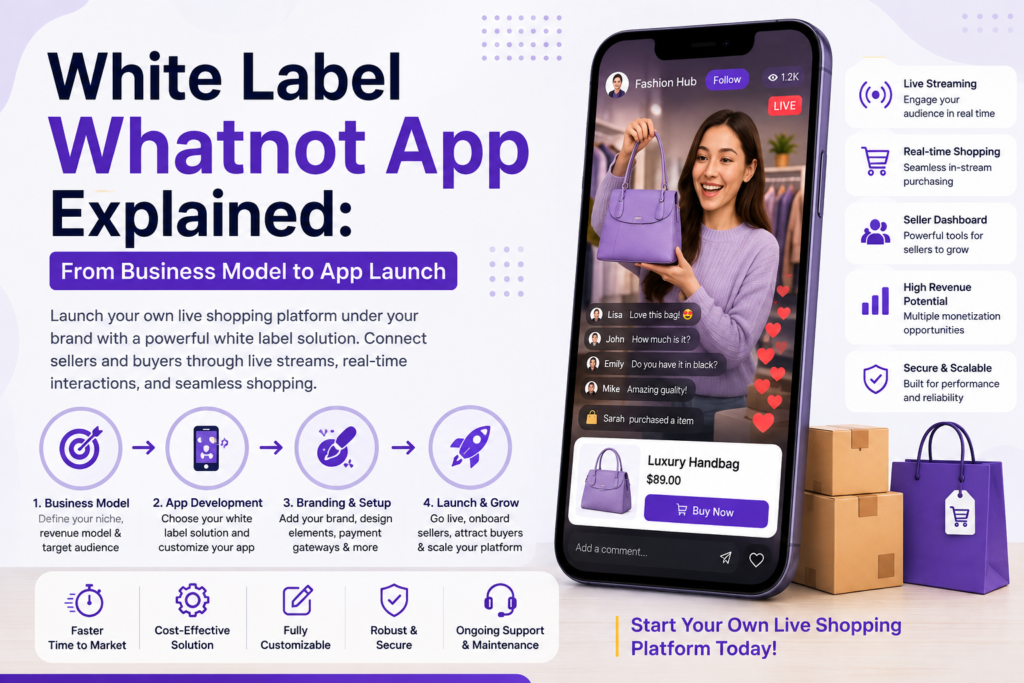
Live shopping has moved beyond being a social media trend. Today, businesses can combine live video, real-time interaction, product discovery, and in-app purchasing to create a shopping experience that feels more engaging than traditional e-commerce. Platforms such as Whatnot have helped demonstrate how effective this model can be, particularly for businesses selling collectibles, fashion, electronics, beauty products, and other niche products.
However, building a live commerce platform from scratch can require considerable development time, technical expertise, and investment. This is where a White Label Whatnot App can provide an alternative.
A white-label solution allows businesses to start with a pre-developed platform and customize it according to their brand, audience, and business requirements. Instead of developing every feature from the ground up, businesses can use an existing technology framework and focus more of their resources on branding, seller acquisition, marketing, and customer growth.
But how does this business model work? What features are required? How much does development involve? And what should businesses consider before launching?
This guide explains the journey from understanding the business model to launching a live shopping application.
What Is a White Label Whatnot App?
A White Label Whatnot App is a ready-made or pre-developed live commerce application that businesses can customize and launch under their own brand.
The concept is based on the functionality of live shopping platforms where sellers can broadcast live video, showcase products, communicate with viewers, and sell products during a live session.
Rather than creating an entire application architecture from the beginning, a business can acquire a white-label solution and customize elements such as:
- Brand name and logo
- Application design
- Color scheme and user interface
- Product categories
- Seller profiles
- Payment options
- Commission structure
- Notifications
- Admin controls
- Live-streaming features
The exact level of customization depends on the solution provider. Some businesses may only need visual branding changes, while others may require modifications to workflows, monetization, or platform functionality.
The main advantage is that businesses can potentially reduce development time while entering the live commerce market with a more established technical foundation.
Understanding the Live Shopping Business Model
Before launching an application, it is important to understand how the business generates revenue.
A live shopping platform generally connects three major groups: sellers, buyers, and the platform operator.
Sellers
Sellers use the platform to host live sessions and showcase products. During a stream, they can demonstrate products, answer questions, interact with viewers, and encourage purchases.
Depending on the platform’s business model, sellers may either be individual creators, established retailers, brands, or businesses.
Buyers
Buyers watch live sessions, interact with sellers, discover products, and complete purchases through the application.
The interactive nature of live commerce can make product discovery more engaging because customers are not simply looking at static product pages.
Platform Owner
The platform owner provides the technology and marketplace environment connecting sellers with customers.
Revenue can potentially come from several sources, including:
- Transaction commissions
- Seller subscription plans
- Listing fees
- Advertising
- Featured product placements
- Premium seller services
- Payment or service fees
A business does not necessarily need to use every revenue stream. The right approach depends on its target market and platform strategy.
Why Businesses Consider White-Label Development
Traditional custom development gives businesses complete control over the technology, but it can also require extensive planning and development.
A custom live shopping application may require separate development for mobile applications, backend infrastructure, databases, streaming technology, payment integrations, administrative dashboards, notifications, and marketplace functionality.
A white-label approach can simplify this process by providing a foundation that already contains many of these components.
Faster Route to Market
One of the biggest reasons businesses consider white-label solutions is speed.
Instead of beginning with an empty development environment, the business starts with an existing application framework. Branding and functionality can then be adjusted before launch.
This does not mean every white-label app can be launched immediately. Testing, customization, security reviews, payment configuration, and deployment are still important.
However, the initial development workload can be lower than building an equivalent product completely from scratch.
Potentially Lower Initial Development Costs
Developing a complex marketplace and live-streaming platform from zero can require a large development team.
A white-label solution can reduce some of the initial engineering requirements because common functionality may already exist.
Businesses can therefore allocate more of their budget toward areas such as marketing, seller acquisition, customer support, and platform growth.
Existing Feature Foundation
Another benefit is that businesses can begin with a defined feature set.
Depending on the provider, the platform may already include features for live streaming, product management, user accounts, payments, notifications, seller management, and administration.
This can help businesses focus on deciding which features actually matter to their audience rather than designing every basic component themselves.
Essential Features of a White Label Whatnot App
A successful live shopping platform needs more than video streaming. The application must connect content, products, transactions, and community interaction into a single experience.
Live Streaming
Live video is the foundation of the platform.
Sellers should be able to start broadcasts, showcase products, interact with viewers, and manage their live sessions.
The quality of streaming infrastructure is particularly important because interruptions, delays, or poor video quality can negatively affect the shopping experience.
Real-Time Chat
Live chat allows viewers to communicate with sellers during broadcasts.
Customers may ask questions about product specifications, availability, sizing, condition, delivery, or pricing.
Moderation tools can also help platform administrators and sellers manage inappropriate messages or spam.
Product Showcase
Sellers should be able to connect products with their live sessions.
A product showcase can display information such as:
- Product name
- Images
- Description
- Price
- Availability
- Variations
- Seller information
This reduces the friction between discovering a product and purchasing it.
Shopping Cart and Checkout
A straightforward checkout process is essential.
Users should be able to review selected products, choose available payment methods, enter shipping details, and complete transactions without leaving the platform unnecessarily.
Seller Dashboard
Sellers need tools to manage their businesses.
A dashboard may allow them to:
- Add products
- Edit product information
- Schedule live sessions
- View orders
- Track sales
- Monitor earnings
- Manage customers
- Review performance
A well-designed dashboard can make the platform more attractive to professional sellers.
Notifications
Notifications can remind users about upcoming live sessions, new products, seller updates, promotions, and order activity.
Personalized notifications can be particularly useful once a platform has enough behavioral data to understand individual customer interests.
Admin Panel
The platform owner needs centralized control.
An administrative dashboard can provide functionality for managing:
- Users
- Sellers
- Products
- Categories
- Orders
- Payments
- Commissions
- Live sessions
- Reports
- Content moderation
The admin panel effectively becomes the operational center of the marketplace.
How to Build a White Label Whatnot App
Although the exact development process varies between providers, the project can generally be divided into several stages.
1. Define the Business Model
The first step is determining what the platform is supposed to accomplish.
Businesses should identify their target audience, product categories, seller types, geographic market, monetization strategy, and expected customer journey.
For example, a platform focused on collectible products may require different marketplace features from one designed for fashion retailers.
2. Select the Feature Set
Not every platform needs every available feature at launch.
Businesses should separate essential launch features from functionality that can be introduced later.
A minimum viable version might include user registration, seller profiles, live streaming, product management, chat, checkout, notifications, and an admin dashboard.
Advanced functionality can then be introduced after collecting user feedback.
3. Choose a Development Approach
At this stage, businesses can evaluate whether custom development, white-label development, or a hybrid approach is more suitable.
A white-label solution can make sense when speed and initial development efficiency are priorities.
Custom development may be more appropriate when a business requires highly specialized workflows or proprietary technology.
4. Customize the Application
The selected solution is adapted to the business’s identity.
This may involve changes to the interface, branding, navigation, product categories, seller workflows, payment options, and other platform components.
The objective should be more than simply replacing a logo. The application should feel consistent with the brand and the expectations of its target users.
5. Integrate Third-Party Services
A live shopping platform may depend on several external technologies.
These can include payment gateways, cloud infrastructure, analytics tools, push notification services, shipping systems, identity verification services, and communication technologies.
The required integrations depend on the platform’s market and business model.
6. Test the Platform
Testing should cover both technical performance and user experience.
Developers should evaluate:
- Streaming performance
- Payment processing
- Login and registration
- Product management
- Checkout
- Notifications
- Chat
- Seller workflows
- Admin functionality
- Application security
- Device compatibility
Load testing is also important because live shopping platforms can experience significant traffic during popular broadcasts.
7. Launch and Monitor
After testing, the application can be deployed to the relevant app stores and infrastructure.
However, launch should not be considered the end of development.
Analytics and user feedback can reveal problems that were not obvious during testing. Businesses should monitor performance and continuously improve the application.
How Much Does a White Label Whatnot App Cost?
There is no single fixed price for a White Label Whatnot App.
Development costs depend on several factors, including:
- Number of platforms
- Feature requirements
- Level of customization
- UI/UX requirements
- Streaming infrastructure
- Payment integrations
- Third-party services
- Admin functionality
- Security requirements
- Maintenance requirements
- Development team location
A basic white-label application with limited customization will generally require a different investment from a highly customized platform with advanced marketplace and streaming capabilities.
Businesses should therefore request a detailed quotation based on their actual requirements instead of relying only on generic development-cost estimates.
White Label vs. Custom Whatnot-Style App
The choice between white-label and custom development depends largely on business objectives.
A white-label solution can be attractive for businesses that want to enter the market quickly, reduce initial development complexity, and use established functionality.
Custom development provides greater flexibility. Businesses can design the entire application architecture, user experience, and feature set around their specific requirements.
A practical approach is to consider the importance of speed, budget, scalability, customization, and long-term product differentiation before making a decision.
Choosing the Right Development Partner
The technology provider can have a significant impact on the final product.
Businesses should look beyond the initial development quote and evaluate the provider’s technical capabilities, communication process, portfolio, customization options, post-launch support, and scalability experience.
It is also worth checking whether the company understands marketplace applications rather than simply offering generic mobile app development.
For businesses managing multiple digital initiatives, an experienced white label seo agency can also become relevant during the growth stage. Once the application is launched, organic visibility, content strategy, technical SEO, and search optimization can help attract potential sellers and customers.
This is particularly important because launching an application does not automatically generate traffic. Businesses need a marketing strategy that supports customer acquisition alongside product development.
Where Triple Minds Fits Into the Picture
Businesses researching development partners may also come across Triple Minds, a technology and digital services company offering solutions for businesses looking to build and scale digital products.
When evaluating a provider such as Triple Minds, businesses should focus on how closely the proposed solution matches their requirements. Important considerations include the desired features, customization level, platform support, integration requirements, estimated timeline, and ongoing maintenance.
The right development partner should be able to explain not only what can be built, but also how the platform can evolve as the business grows.
For a live commerce business, this long-term perspective matters because the initial application may only be the first stage of the product roadmap.
Strategies for a Successful App Launch
Technology is only one part of launching a live shopping platform.
Businesses also need to create enough activity to make the marketplace attractive to both sellers and buyers.
Start With a Specific Niche
Instead of targeting everyone immediately, a platform can begin with a focused category.
A niche community can make it easier to recruit relevant sellers and create content that appeals to a specific audience.
Recruit Sellers Before Launch
A live shopping marketplace needs sellers and content before it can attract a large customer base.
Businesses can work with selected sellers before launch and encourage them to schedule initial live sessions.
This can give the platform some activity from day one.
Build a Content Strategy
Live commerce depends heavily on content.
Businesses can promote upcoming broadcasts through social media, email campaigns, blogs, video content, and other marketing channels.
Search-focused content can also help potential users discover the platform when researching products or live shopping experiences.
Track User Behavior
After launch, analytics can show which categories, broadcasts, products, and sellers are generating the most engagement.
This information can help businesses improve their recommendations, marketing strategy, seller acquisition, and product roadmap.
Common Mistakes to Avoid
A technically functional application does not guarantee a successful marketplace.
One common mistake is trying to launch with too many features. A complicated interface can make the platform harder for new users to understand.
Another mistake is focusing entirely on development while neglecting seller acquisition and marketing.
Businesses should also avoid choosing a provider solely because it offers the lowest development price. Poor scalability, limited support, weak security, or restricted customization can create larger costs later.
Finally, businesses should think about maintenance from the beginning. Operating a live shopping platform requires updates, security improvements, bug fixes, infrastructure management, and feature enhancements.
Final Thoughts
A White Label Whatnot App can provide businesses with a practical starting point for entering the growing live commerce market. Instead of developing every component from scratch, businesses can begin with an established application framework and customize it around their brand and business model.
The key is to look beyond the application itself.
A successful live shopping platform needs reliable technology, useful seller tools, a smooth buyer experience, effective monetization, strong marketing, and continuous improvement after launch.
Businesses should therefore define their model first, identify essential features, evaluate development approaches, compare potential technology partners, and plan their acquisition strategy before going live.
With the right combination of technology and business planning, a live shopping application can become more than an e-commerce storefront—it can develop into an interactive marketplace where sellers and customers connect through real-time experiences.
